

Revieko
Repo-aware structural signals for PR review
Revieko
Repo-aware structural signals for PR review
Make architectural drift visible in pull requests
Review 2,000-line PRs by starting with the 30 lines that matter most. Shorten time-to-trust without slowing dev flow.
Revieko learns a repo-specific baseline and surfaces structural risk hotspots in every PR comment — no generic rules, no review spam, just where to look.
No config • Install once • Default: warn • No credit card
Revieko · High risk | risk=58.7 | hotspots=6
Architecture drift detected
def validate(x):        # ← hotspot: nested_logic
    if x < 0:           # ← hotspot: magic_num
        return False
    return True

result = calc(x) + 5    # ← hotspot: side_effect

class API:              # ← hotspot: stateful
    def __init__(self):
        self.conn = None# ← hotspot: hidden_dep
A COMPLETE WORKFLOW
Triage first → Read later → Decide faster — inside your PR flow
Revieko doesn’t replace review. It makes structural change observable, so humans can focus judgment where it matters.
TRIAGE
High-signal hotspots + per-file actions. Attention map = the first 30 lines to read.
ALIGN
Repo-specific baseline: what’s “normal here”. No universal rules. No generic spam.
DECIDE
Warn / require changes / pass. Default: warn, not block — configurable later.
EXPLORE
Full report (HTML/MD/JSON) + glossary when you need depth beyond the PR summary.
INSTALL ONCE
Every PR gets an attention map
Baseline builds automatically from your repo history. No setup required to start.
Baseline builds automatically
Revieko learns repo-specific invariants from history.
Get focused PR review
Risk summary + top hotspots + per-file actions — in one evolving comment.
WHY THIS MATTERS
Drift hides inside “reasonable” changes
Tests can pass while architectural drift accumulates. The code works — the structure shifts. The cost shows up later as cognitive load, slower changes, and more regressions.
- AI increases PR volume and PR size.
- Humans still own judgment and accountability.
- The bottleneck moved: writing code → validation and trust.
Revieko is a structural radar: it points you to hotspots where review judgment is most likely required.
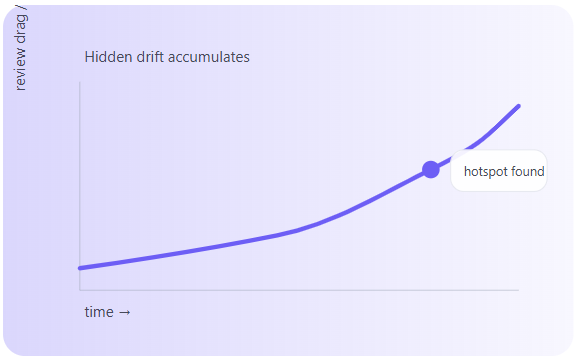
Linters and tests can stay green while structure quietly shifts.
AI AT MACHINE SPEED
AI optimizes locally. Structure breaks globally
Agents can generate locally-correct code at machine speed. But they can violate repo norms, boundaries, and contracts — even when tests pass.
Revieko surfaces repo-level drift, boundaries, and blast radius as high-signal hotspots, so reviewers can triage risk fast — without reading 2,000 lines.
Works great for Cursor/Copilot/agents PRs
Focuses on structure, not cosmetics
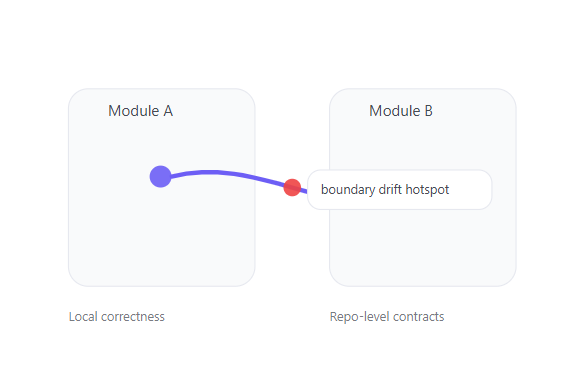
A change can work locally while violating repo-level boundaries.
01 · PR comment
Risk summary + top hotspots.
Revieko PR review: HIGH
risk=58.7 | hotspots=6
Top hotspots:
- struct_pattern_break (yield+state)
- new_abstraction
- hidden_dep
Actions:
- Requires attention in checkout/
02 · Status check
Fail / warn / pass — configurable.
Status: WARN
Reason:
Structural drift detected
Default: warn (not block)
Configure policies later
03 · Full report
HTML/MD/JSON when you need depth.
Report includes:
- hotspots (line-level)
- per-file actions
- glossary (drift types)
- exports: html/md/json
WHAT IT SURFACES
High-signal structural drift — line by line
Not cosmetics. Not lint noise. Hotspots point to concrete lines where structure deviates from your repo baseline.
Revieko · High risk | risk=69.49 | hotspots=10
These hotspots = top 5% to review first
def _goal_generator(history):                      # ← hotspot: struct_pattern_break (yield + state)
    if all(norm(goal - g) > 2.0 for g in history[-3:]):  # ← hotspot: struct_pattern_break (complex filter)
        yield goal

damped = J.T @ J + damping * np.eye(N)            # ← hotspot: struct_pattern_break (algorithmic shift)

class _StateManager:                               # ← hotspot: struct_pattern_break (new abstraction)
    pass
Common drift signals
- Architectural drift — new abstractions and responsibilities appear or shift
- Boundary drift — cross-module moves that increase coupling
- Hidden coupling — implicit dependencies introduced
- State introduced — stateful objects appear where the repo is typically stateless
- Control-flow complexity — generators with state, dense branching, deep nesting
- Heuristic drift — mixed rules without clear rationale
- Pattern breaks — structure deviates from repo baseline (the “almost right” trap)
What it does NOT do
- No style nitpicks
- No generic best-practice spam
- No wall of comments
- Not a linter. Not a bug finder
- Signals only where structure deviates
High signal-to-noise by design.
HIGH SIGNAL-TO-NOISE
Designed to stay useful at scale
Pointed highlights, structural guardrails, transparent outputs — so review stays human-sized.
Pointed highlights
Top hotspots concentrate most structural risk. No review spam.
Structural guardrails
Focused on repo-specific invariants — not cosmetics.
Transparent outputs
Short PR summary + full report + glossary when you need depth.
BY ROLE
What you get — depending on what you own.
Same signal, different outcomes: faster triage, clearer ownership, steadier architecture.
Developers
Tech leads
Engineering managers
- Less review churn: reviewers focus on hotspots, not everything.
- Faster time-to-trust for AI-generated changes.
- Clear “what changed structurally” without reading thousands of lines.
- Repo-aware guardrails that evolve with your codebase.
- Early detection of architectural drift before it compounds.
- Better alignment: structure becomes observable in PRs.
- Reduced review drag and fewer rubber-stamped PRs.
- More consistent gates without blocking dev flow (default: warn).
- Clearer ownership and less hidden complexity over time.
PLANS THAT GROW WITH YOU
Start free. Upgrade when it proves value
Revieko is read-only by default, runs on diffs, and stays low-noise.
FREE
$0 / month
- Core PR comment + status check
- Read-only by default
- Runs on diffs
- Uninstall anytime
TEAM (pilot)
pilot / month
- Org-wide settings
- Reporting
- Advanced controls
- Best for teams standardizing review guardrails
ENTERPRISE (pilot)
Custom
- SSO / audit logs
- Org-wide governance
- Security & compliance options
- Dedicated support
FAQ
Quick answers for busy reviewers
Short and practical. No hand-wavy promises.
Does it replace code review?
No. Revieko shortens time-to-trust by surfacing where judgment is needed most — hotspots and per-file actions, not a replacement for human accountability.
Will this create review theater?
No. Revieko is built for high-signal triage: a small set of top hotspots, not a stream of comments. The goal is to reduce cognitive load and make review more real — not more performative.
How does Revieko reduce ownership debt from AI-generated code?
By making structural change observable. Hotspots show where the repo’s structure bends so humans can explicitly accept, adjust, or reject the shift. As your team adopts new patterns, the repo baseline can refresh so accepted structure stops being flagged as anomalous.
Is this a linter or a security scanner?
No. Linters enforce style and local rules. Security scanners focus on known vulnerabilities. Revieko targets repo-abnormal structural drift: boundary moves, hidden coupling, state introduced, and other “correct-but-dangerous” shifts.
How does baseline work?
Revieko builds a repo-specific baseline from your repo history and compares new PR diffs against that baseline. The baseline can evolve over time as your repo changes and accepted patterns become normal.
Does it block merges?
Default: warn (not block). You can configure pass / warn / fail policies later.
STILL HAVE QUESTIONS
Don’t trust us — ask your favorite LLM
>_ What makes Revieko different from linters, code review bots, and generic LLM reviewers — and why might it be a better choice for my team?
Pick your oracle:
UNDER THE HOOD
Structural ML (not LLM semantics)
Revieko treats code as structural complexity — not as natural language. It scores deviations relative to your repo baseline and surfaces high-signal hotspots for review triage.
How it works
We encode code structure into a compact representation and score structural deviations relative to your repo baseline. The output is intentionally human-sized: a short PR summary plus a full report when you need it.
Want the deep dive? Learn more under the hood →
Under the hood: compact structural representation → deviation scoring → hotspots

© 2026 • Build systems that reconstruct the structure of reality